
WHO declares Ebola outbreak in DRC and Uganda a global health emergency
Ai generated image
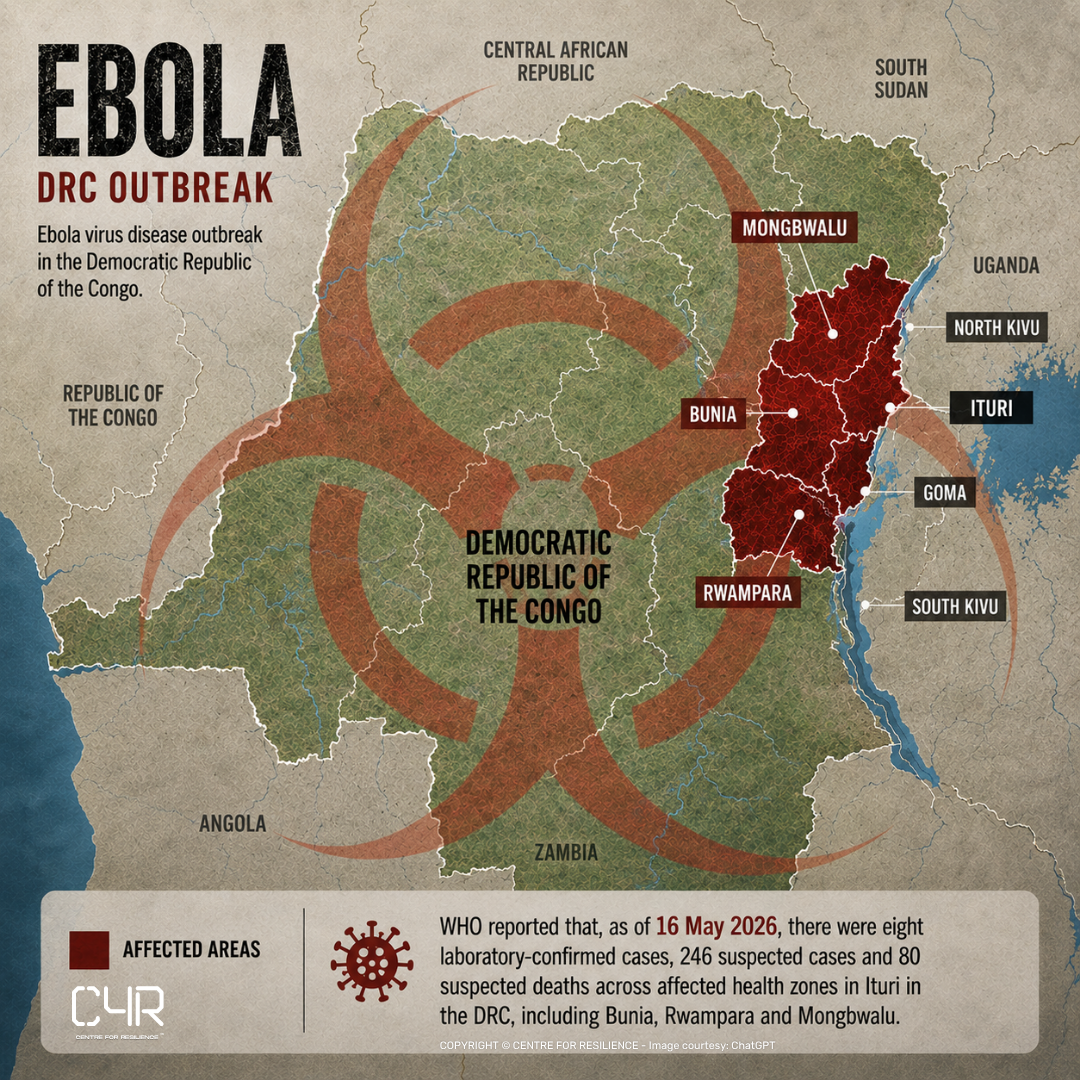
As of 16 May 2026, there were eight laboratory-confirmed cases, 246 suspected cases and over 80 suspected deaths across affected health zones in Ituri Province in the DRC, including Bunia, Rwampara and Mongbwalu.
The World Health Organization has declared the Ebola outbreak in the Democratic Republic of the Congo and Uganda a public health emergency of international concern, following the spread of Ebola disease caused by the Bundibugyo virus. WHO reported that, as of 16 May 2026, there were eight laboratory-confirmed cases, 246 suspected cases and 80 suspected deaths across affected health zones in Ituri Province in the DRC, including Bunia, Rwampara and Mongbwalu. WHO has also confirmed that the outbreak involves Ebola disease caused by Bundibugyo virus, a strain for which there is currently no licensed vaccine or specific therapeutic.
The outbreak is strategically significant because it is not confined to one isolated health district. Reuters reported that WHO declared the outbreak a global health emergency after cases and suspected spread were recorded in the DRC and Uganda, including concern over cross-border movement and the risk to neighbouring countries. AP reported that more than 300 suspected cases and 88 deaths had been reported, and that the outbreak’s detection was delayed, with more than 50 deaths occurring before health officials were alerted.
This is the DRC’s 17th recorded Ebola outbreak, but the current event is especially concerning because of the strain involved, the absence of strain-specific vaccines and therapeutics, and the difficult operating environment in eastern DRC. Ituri Province is affected by insecurity, population movement, mining activity and fragile health infrastructure. These conditions can make surveillance, contact tracing, isolation, safe burial practices, risk communication and community trust much harder to maintain at speed. WHO’s regional office has confirmed it is scaling up support to the DRC Government, while Africa CDC has called for urgent regional coordination following the outbreak in Ituri and an imported Ebola Bundibugyo case reported by Uganda.
The health-security risk is therefore wider than the immediate clinical case count. Ebola outbreaks test whether health systems can detect disease early, isolate cases, trace contacts, protect health workers, communicate effectively with communities and maintain essential services while responding to an emergency. Where health systems are already under strain, the outbreak can quickly become a compound crisis - health, governance, logistics, community confidence and regional mobility all interacting at once.
For Africa, the outbreak is a regional resilience test. The DRC and Uganda share cross-border population flows, trade routes and transport links. Reuters reported that Uganda confirmed an outbreak involving the Bundibugyo strain, while WHO and Africa CDC responses point to the need for coordinated surveillance, emergency management and cross-border health controls. The challenge is to contain the disease without generating counterproductive border closures, panic movement, stigma or unmonitored crossings.
The international response will need to balance urgency with precision. Ebola is a severe disease, but outbreak control depends heavily on trust, rapid detection, safe clinical management, health-worker protection and local cooperation. Heavy-handed measures that disrupt livelihoods or drive people away from formal health systems can make response harder. The resilience objective should be to reduce transmission while preserving community access to trusted care, food, markets, transport and public information.
This outbreak also raises a deeper strategic issue: the inequity of medical countermeasure availability. WHO has noted that, unlike Ebola virus disease caused by the Zaire strain, there is no licensed vaccine or specific therapeutic against Bundibugyo virus. That matters because outbreak response capability is not only about field deployment. It is also about research capacity, diagnostics, regional manufacturing, stockpiles, logistics and the speed at which global health systems can adapt to a less common pathogen.
The current Ebola outbreak should therefore be treated as both a public-health emergency and a resilience warning. The immediate priority is containment. The broader lesson is that pandemic and epidemic readiness cannot be limited to the diseases and strains for which the world already has comfortable countermeasures. Africa’s health-security resilience depends on surveillance, diagnostics, local manufacturing, trusted primary care, emergency logistics and the ability to respond across borders before local outbreaks become regional crises.
What This Means:
The Ebola outbreak in DRC and Uganda matters because it sits at the intersection of infectious disease, weak health infrastructure, conflict-affected geography and cross-border mobility.
This is not simply a medical story. It is a systems story. If surveillance is delayed, if contact tracing is disrupted, if health workers are exposed, if communities distrust authorities, or if cross-border controls are poorly managed, the outbreak can expand beyond the formal case count very quickly.
For governments and institutions, the key priorities are:
Rapid case detection and laboratory confirmation
Strong infection prevention and control in health facilities
Contact tracing across affected communities and borders
Health-worker protection and emergency supplies
Transparent public communication to reduce misinformation and panic
Cross-border coordination between DRC, Uganda and neighbouring states
Avoidance of blunt border closures that may push movement into informal routes
Fast research and deployment pathways for diagnostics, treatments and vaccine candidates where possible
The most important strategic point is that this outbreak involves the Bundibugyo strain, not the better-known Zaire strain. That changes the risk profile because the existing Ebola vaccine and therapeutic ecosystem is not equally applicable across all Ebola virus species. WHO has specifically identified the lack of licensed vaccine or specific therapeutics against Bundibugyo virus as a major concern.
Resilience Lens:
This outbreak is a health-system resilience test across five layers.
1. Detection resilience
The delay between early deaths and formal alerting is a major warning signal. A resilient infectious-disease system must detect unusual mortality quickly, especially in high-risk regions with a history of viral haemorrhagic fever.
2. Clinical resilience
Ebola response depends on safe isolation, trained staff, protective equipment, infection prevention and control, and treatment units that can function without becoming amplification points for transmission.
3. Community resilience
Trust is central. Communities need clear information, culturally appropriate engagement, safe burial protocols and confidence that health facilities will help rather than expose them to additional risk.
4. Cross-border resilience
DRC and Uganda require coordinated surveillance, contact tracing, travel screening and public-health messaging. Border closures alone may be ineffective if they push people into informal crossing points.
5. Medical countermeasure resilience
Bundibugyo virus highlights a global preparedness gap. The world is better prepared for some Ebola strains than others. That is a strategic vulnerability for Africa and for global health security.
Sources:
WHO Disease Outbreak News - Ebola disease caused by Bundibugyo virus, Democratic Republic of the Congo.
WHO Africa - Democratic Republic of the Congo confirms new Ebola outbreak, WHO scales up support.
Reuters - WHO declares Ebola outbreak in Congo, Uganda an emergency of international concern.
AP News - WHO declares global health emergency over Ebola outbreak in Congo and Uganda.
Al Jazeera - WHO declares Ebola outbreak in DR Congo, Uganda a global health emergency.
About C4R™ - CENTRE FOR RESILIENCE :
C4R™- CENTRE FOR RESILIENCE provides curated, source-based analysis and reporting, combining verified news with strategic insight and resilience-focused interpretation. For in depth analysisof topics like these reach out to C4R™.
C4R™ - CENTRE FOR RESILIENCE is an independent, Australian-based Think Tank initiative advancing economic, social, infrastructure and leadership resilience through research, measurement and practical programs with business, government and community partners.
Media enquiries: via the C4R Contact page.