
Adelaide risks missing major tech investment as industrial land supply tightens
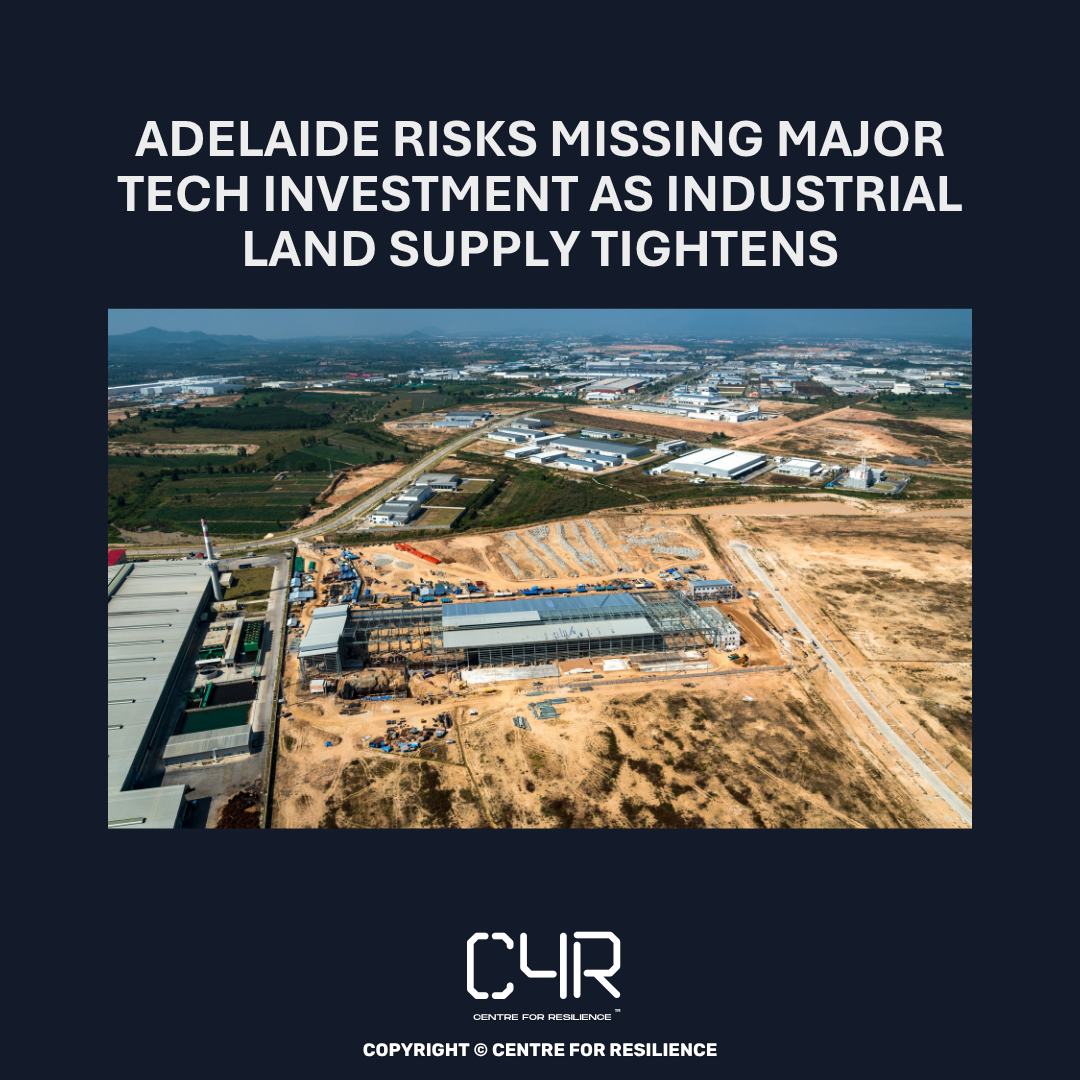
Development-ready industrial land in Greater Adelaide has fallen from 146 hectares to 124 hectares since May 2025.
Adelaide’s industrial land challenge is starting to look less like a planning inconvenience and more like an economic constraint.
The Property Council says Greater Adelaide could run out of development-ready industrial land within two years if action is not taken quickly to unlock and service more sites. Its Land Locked report argues that industrial and employment land underpins manufacturing, warehousing, logistics and distribution, and warns that a shortage of ready land will make it harder for South Australia to absorb population growth and attract major investment.
That matters because industrial land is not just a real estate category. It is the physical base for jobs, freight movement, advanced manufacturing, data infrastructure and everyday business expansion. When land is zoned but not actually ready for development, the headline supply number can look healthier than the real investment pipeline. That is where Adelaide appears most exposed. The Property Council is calling for a minimum $250 million fund to accelerate enabling infrastructure and remediation, annual release targets of 25 hectares of serviced industrial land, and better coordination across utilities and approvals.
The strategic issue is timing. Large industrial users and technology operators do not wait indefinitely for power, water, access roads and site readiness to catch up. If another market can offer certainty faster, capital will move. In that sense, the debate is no longer simply about whether South Australia supports growth in principle. It is about whether the state can convert policy intent into development-ready capacity when demand arrives. That is the gap the Property Council is now putting squarely on the table.
Resilience Lens:
Economic resilience is stronger when a city has room to grow at the moment growth is demanded. If Adelaide cannot bring industrial land online quickly enough, it risks missing not only individual projects, but broader diversification opportunities across logistics, digital infrastructure, advanced industry and supply-chain capacity. A shortage of ready employment land can therefore become a resilience weakness, because it narrows the state’s ability to absorb shocks, attract new capital and rebalance its economy over time.
Sources:
About C4R™ - CENTRE FOR RESILIENCE :
C4R™- CENTRE FOR RESILIENCE provides curated, source-based analysis and reporting, combining verified news with strategic insight and resilience-focused interpretation. For in depth analysis of topics like these reach out to C4R™.
C4R™ - CENTRE FOR RESILIENCE is an independent, Australian-based Think Tank initiative advancing economic, social, infrastructure and leadership resilience through research, measurement and practical programs with business, government and community partners. Learn more at https://www.c4resilience.com/.
Media enquiries: via the C4R Contact page.