
Australia’s Workforce Challenge Is a National Resilience Challenge
C4R - CENTRE FOR RESILIENCE Hosts Jobs, Skills & Migration Briefing in Adelaide
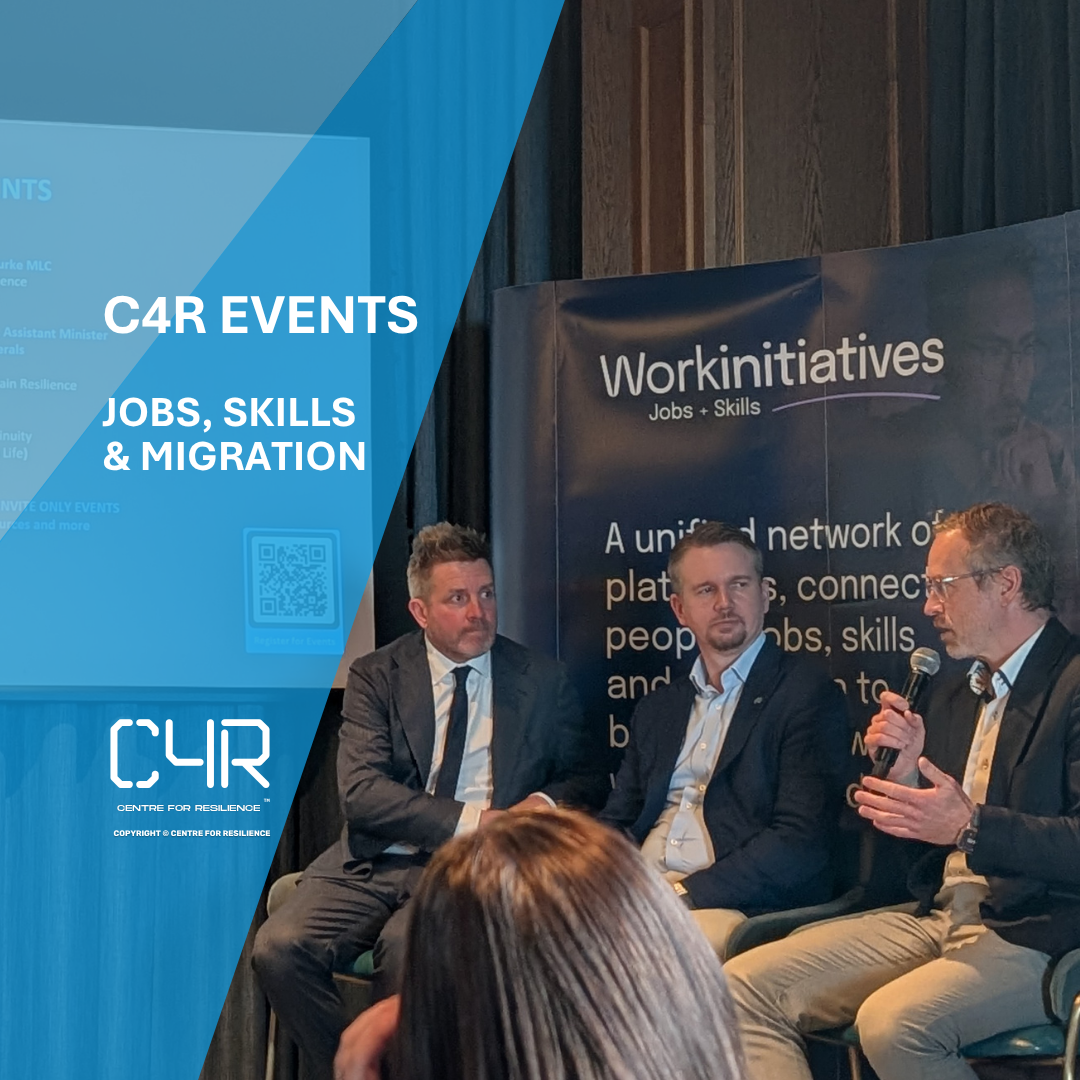
On Tuesday, 21 July 2026, C4R - CENTRE FOR RESILIENCE hosted the Jobs, Skills & Migration Briefing Session with Workinitiatives at the Sofitel Adelaide.
The briefing brought together representatives from government, business, industry associations, professional bodies and the wider community to examine one of Australia’s most significant economic and organisational challenges - whether the country has the people, skills, migration pathways and workforce systems required to support future growth.
The event featured:
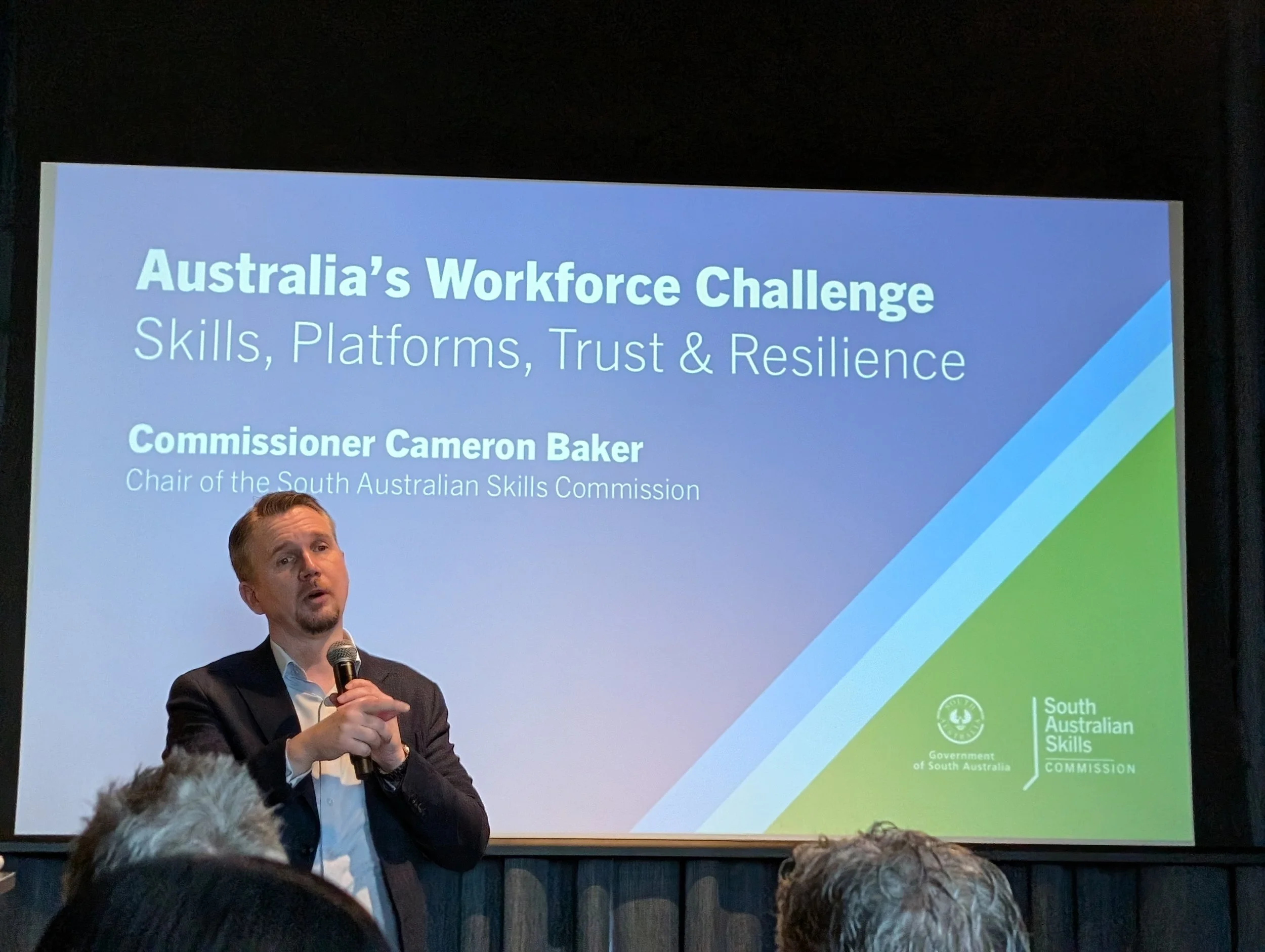
Commissioner Cameron Baker, Chair of the South Australian Skills Commission;
Chris Carman, Co-Founder of Workinitiatives; and
Sam Dighton, Chief Executive of the Committee for Adelaide.
The panel discussion was moderated by Tom Pennington, Technology and Transformation Lead at C4R - CENTRE FOR RESILIENCE.
The discussion reinforced that Australia’s skills shortages are not isolated recruitment problems. They are structural issues that affect productivity, project delivery, housing, health, education, defence, infrastructure and business continuity.
Suggested photograph: Wide image of the panel and audience at the Sofitel Adelaide.
The Scale of Australia’s Workforce Challenge
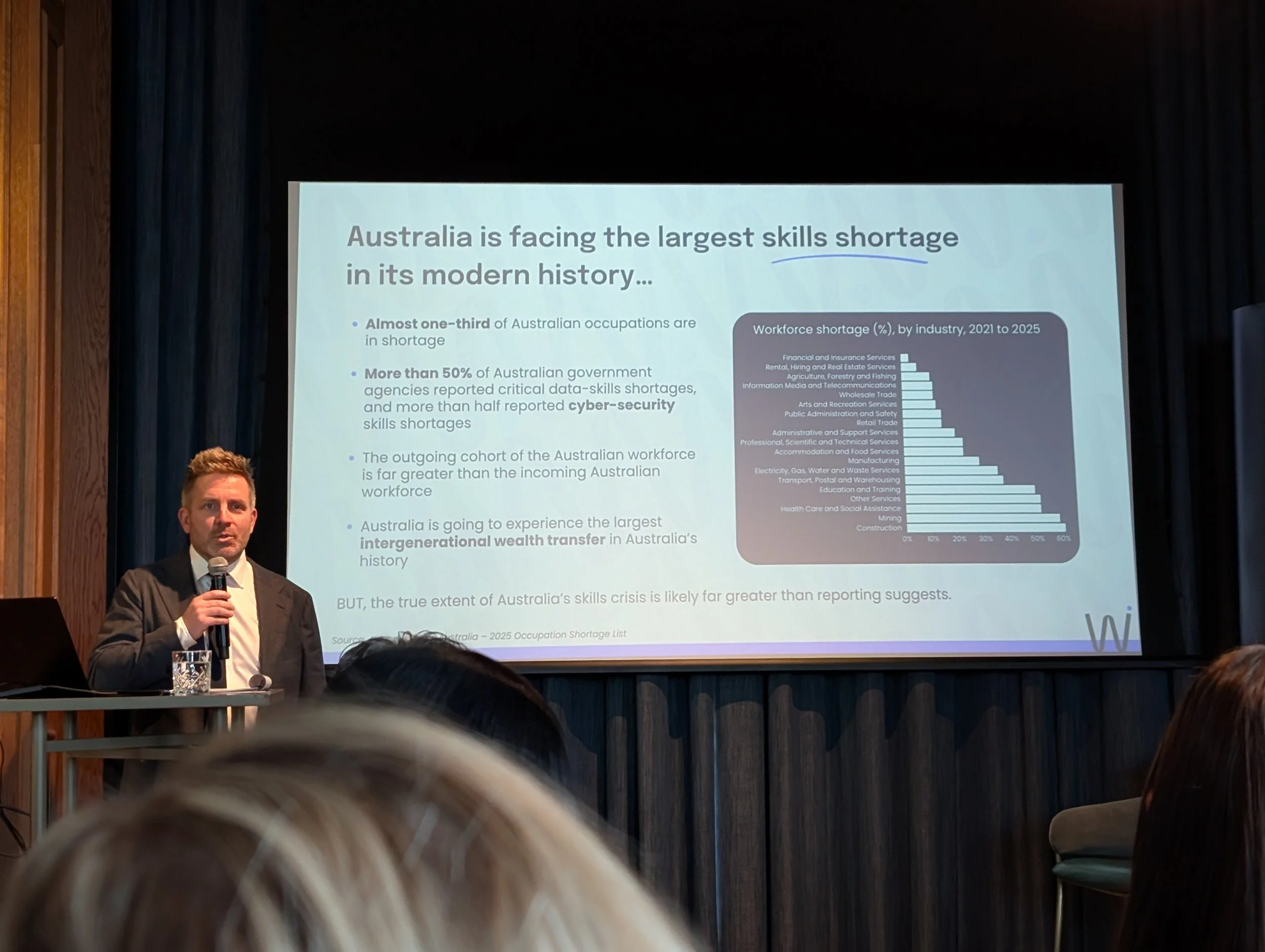
Jobs and Skills Australia’s 2025 Occupation Shortage List found that 29 per cent of assessed occupations remained in national shortage.
The most significant shortages continue to be experienced across health, education, construction, engineering, technical trades and other occupations essential to the delivery of Australia’s economic and social infrastructure.
These shortages are already creating practical consequences for organisations and communities.
Employers are experiencing longer recruitment periods, increased wage pressures, difficulties retaining staff and growing competition for specialised workers.
Major projects can be delayed because the required trades, engineers, technical specialists or project managers are unavailable.
Existing employees are often required to carry additional workloads, increasing the risk of fatigue, reduced productivity and staff turnover.
Workforce shortages also affect the delivery of essential services.
A shortage of health professionals can reduce access to care. A shortage of teachers can affect educational quality. A shortage of construction workers can constrain housing supply and infrastructure delivery.
When these pressures occur across many industries at the same time, they become a systemic resilience issue rather than an individual employer problem.
Workforce Capability as Essential Infrastructure
Australia traditionally thinks of infrastructure as roads, rail, ports, energy networks, hospitals and telecommunications systems.
However, each of these systems depends on people.
Infrastructure cannot be designed, constructed, operated, maintained or renewed without a capable workforce.
For this reason, workforce capability should be treated as a form of essential economic and social infrastructure.
The ability to attract, train, deploy and retain workers directly influences whether governments and industries can convert policies, investment commitments and project announcements into delivered outcomes.
South Australia has substantial opportunities across defence, advanced manufacturing, critical minerals, health, construction, renewable energy, space, technology and tourism.
However, these opportunities can only be realised if the state has sufficient workforce capacity.
A strong project pipeline without the workers required to deliver it can result in delays, cost escalation and competition between sectors for the same limited skills.
Commissioner Cameron Baker - Aligning Skills with Industry Demand
Commissioner Cameron Baker provided an important overview of the current workforce environment and the need for stronger alignment between skills development, education, migration and industry demand.
The discussion highlighted that workforce planning must be based on a clear understanding of the occupations, qualifications and capabilities employers actually require.
Training places alone do not guarantee successful outcomes.
Education and training systems must be connected to genuine employment pathways, while employers need to communicate their future workforce requirements early enough for the system to respond.
The challenge also extends beyond the number of workers available.
Employers increasingly require combinations of technical capability, digital literacy, communication skills, leadership and adaptability.
As industries adopt new technologies and operating models, the content and delivery of training must evolve accordingly.
C4R - CENTRE FOR RESILIENCE sincerely thanks Commissioner Baker for contributing the South Australian Skills Commission’s insights and perspectives to the briefing.
Chris Carman and Workinitiatives - Connecting the Workforce System
Chris Carman presented the platform-based approach being developed by Workinitiatives ( a C4R Member ) to better connect employers, skills, workforce demand, talent and career pathways.
Workforce information is currently fragmented across businesses, recruiters, education providers, government agencies, industry associations and migration programmes.
This fragmentation can make it difficult to identify where shortages are emerging, which skills employers need and where workers can find viable career pathways.
A more connected workforce system can improve visibility and coordination.
Better data may allow employers and policymakers to identify emerging shortages earlier, align training programmes with genuine demand and provide workers with clearer information about opportunities.
Digital platforms can also help connect individuals with training, employment and career-development pathways that may otherwise be difficult to navigate.
However, technology alone is not sufficient.
Successful workforce platforms must be supported by cooperation between employers, government, education providers and community organisations.
C4R - CENTRE FOR RESILIENCE thanks Chris Carman and Workinitiatives for partnering with C4R and presenting a practical, systems-based response to the workforce challenge.
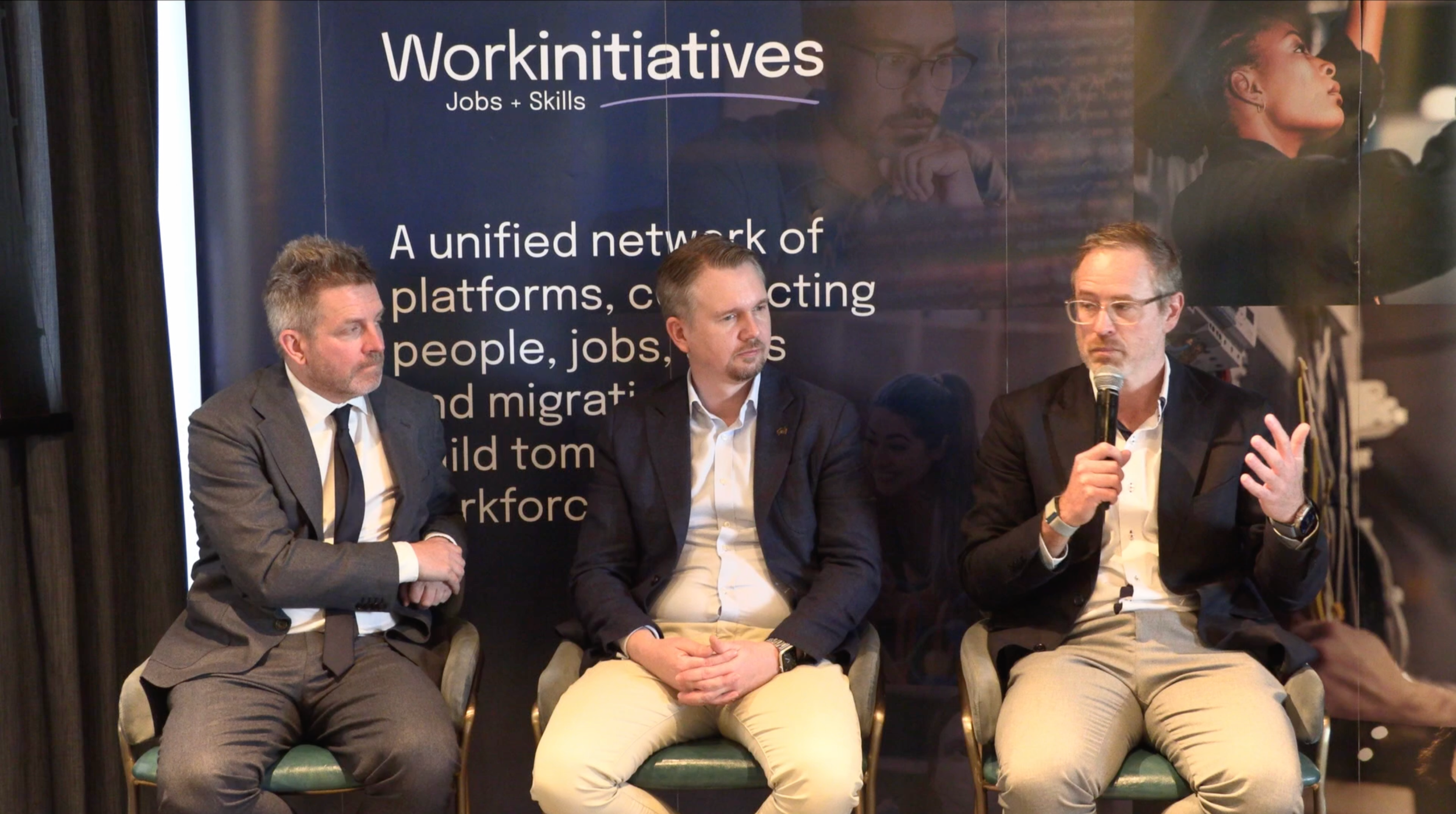
Sam Dighton and the Committee for Adelaide - Workforce and City Growth
Sam Dighton contributed an important city and economic-development perspective to the discussion.
Adelaide’s ability to attract investment, deliver major projects and support future population growth is directly connected to its workforce capability.
South Australia is competing with other jurisdictions for many of the same engineers, tradespeople, health professionals, technology specialists and skilled workers.
This means that workforce attraction cannot be separated from broader questions about Adelaide’s liveability, housing, transport, education, career opportunities and community connection.
Attracting people to South Australia is only the first step.
The state must also provide the conditions required for people to remain, build careers and establish long-term connections with the community.
For skilled migrants, this includes effective settlement pathways, recognition of qualifications, access to employment and support for accompanying family members.
For interstate workers, it includes confidence that South Australia offers competitive career opportunities and a strong long-term economic outlook.
C4R - CENTRE FOR RESILIENCE thanks Sam Dighton and the Committee for Adelaide for contributing this important perspective.

Migration Is Essential, but It Is Not the Only Answer
Skilled migration will remain an essential part of Australia’s workforce strategy.
However, migration cannot be treated as a stand-alone response.
It must be aligned with verified workforce demand and supported by effective systems for qualification recognition, employment matching, housing, settlement and community participation.
There is also a risk that poorly coordinated migration settings may bring skilled people into Australia without providing clear pathways into employment that reflects their qualifications and experience.
This represents a loss for both the individual and the economy.
At the same time, migration cannot replace investment in the Australian workforce.
Governments, employers and education providers must continue to strengthen:
apprenticeships and traineeships;
vocational education and training;
university-to-industry pathways;
professional development;
mid-career retraining;
workforce participation;
career progression; and
employee retention.
The most resilient workforce strategy combines skilled migration with sustained investment in people already living and working in Australia.
The Ageing Workforce and Knowledge Transfer
Another major concern is the ageing of the workforce across key sectors.
Many experienced workers are approaching retirement at the same time that employers are struggling to attract sufficient numbers of new entrants.
This creates both a labour shortage and a knowledge-transfer challenge.
When experienced workers leave an organisation, they may take with them technical expertise, client relationships, operational knowledge and an understanding of systems that has developed over decades.
Without succession planning, mentoring and structured knowledge transfer, this capability can be difficult and expensive to replace.
Organisations must therefore look beyond current vacancies and consider the future composition of their workforce.
Workforce resilience requires an understanding of critical roles, retirement exposure, capability gaps and the time required to develop replacements.
No Single Organisation Can Solve the Problem
The central message from the briefing was clear.
Australia’s workforce challenge cannot be solved by one business, one government agency, one educational institution or one industry association.
It requires coordinated action across:
Commonwealth, state and local government;
employers and industry bodies;
universities and vocational education providers;
migration and settlement services;
workforce platforms and recruiters;
professional associations; and
communities.
The issue must also be considered over a longer timeframe.
Short-term recruitment responses may assist individual employers, but they do not necessarily strengthen the wider workforce system.
A resilient approach requires better data, earlier identification of emerging shortages, stronger career pathways and sustained cooperation between the organisations responsible for workforce planning and delivery.
Key Findings
The key findings from the Jobs, Skills & Migration Briefing Session included:
1. Skills shortages are systemic. They affect multiple industries and have broader consequences for productivity, services and project delivery.
2. Workforce capability is essential infrastructure. Projects and investments cannot be delivered without people with the required skills and experience.
3. Migration must be better connected to industry demand. Attraction, qualification recognition, settlement and retention must form part of a coordinated system.
4. Australia must invest in its existing workforce. Training, retraining, career progression and retention remain essential.
5. The ageing workforce creates a capability-transfer risk. Organisations require stronger succession planning and knowledge-transfer processes.
6. Better data and digital platforms can improve coordination. Employers, workers, education providers and government need clearer visibility of workforce supply and demand.
7. Collaboration is essential. No single organisation or sector can address the challenge alone.
A Resilience Issue
Australia’s workforce challenge is not solely a jobs issue.
It is also a productivity issue, an investment issue, a social infrastructure issue and a sovereign-capability issue.
For organisations, workforce shortages can limit growth, increase costs and reduce operational resilience.
For governments, they can constrain the delivery of housing, health, education, infrastructure and economic-development priorities.
For communities, they can affect access to services and opportunities.
C4R - CENTRE FOR RESILIENCE thanks Commissioner Cameron Baker, Chris Carman, Sam Dighton and Tom Pennington for their contributions.
We also thank Workinitiatives for partnering with C4R to present the session, and the Committee for Adelaide for contributing to the panel discussion.
Most importantly, we thank all guests, C4R members, employers, professional organisations and industry associations who attended and contributed.
The strength of the discussion reflected the importance of the issue.
C4R - CENTRE FOR RESILIENCE looks forward to continuing the conversation and supporting stronger connections between government, industry, education and the community.
Suggested closing photograph: Group photograph of speakers, hosts and attendees following the briefing.
ABOUT THE SPEAKERS:
Commissioner Cameron Baker
South Australian Skills Commissioner
Chair of the South Australian Skills Commission
Commissioner Cameron Baker has more than 20 years of experience across vocational education and training, apprenticeships, workforce policy and industry engagement.
His professional background includes senior roles with Apprenticeships Victoria, Manufacturing Skills Australia, the Transport and Logistics Industry Skills Council, the Canberra Institute of Technology and the Department of Defence.
Commissioner Baker will provide the keynote address, examining South Australia’s skills system, current workforce pressures and the roles of employers, training providers, workers and government.
Chris Carman
Chief Executive Officer, Workinitiatives
Chris Carman has more than 20 years of experience across workforce strategy, technology and policy.
He works with government, industry and communities on employment, skills and talent pipeline solutions.
Chris will present the Workinitiatives model and examine how workforce technology may help connect employers, jobseekers, training providers, industry bodies, governments and regions.
The presentation will also consider the evidence, governance and assurance required before a workforce platform can operate as trusted public-purpose infrastructure.
Sam Dighton
Chief Executive, Committee for Adelaide
Sam Dighton brings extensive domestic and international experience across legal, corporate, infrastructure and strategic government roles.
His executive experience includes senior positions with ElectraNet and Renewal SA, supported by Australian and international qualifications and executive education.
Sam will contribute a city and economic development perspective, examining how workforce attraction and retention connect with Adelaide’s growth, competitiveness, housing, infrastructure and future industry ambitions.1.1