
South Australia’s Two Speed Economy
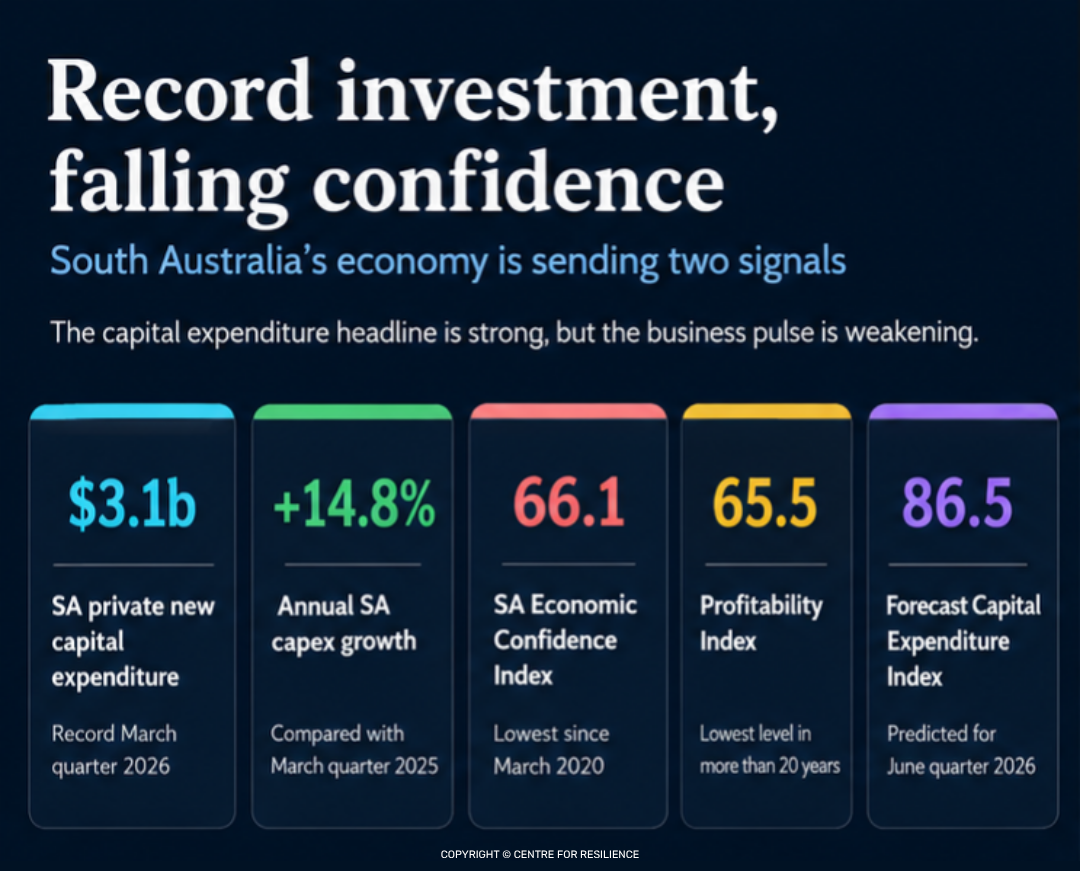
Record investment, falling confidence - South Australia’s economy is splitting into two speeds.
South Australia has recorded a strong investment headline, with private new capital expenditure reaching a record $3.1 billion in the March 2026 quarter.
That is good news. It points to business investment, productive capacity and confidence in parts of the economy, but it is not the whole story
The South Australian Business Chamber’s March 2026 Survey of Business Expectations (SOBE) shows a much tougher picture at the operating level. Business confidence fell sharply, general business conditions weakened, sales declined, profitability reached a 20-year low and many businesses reported that high costs, fuel disruption and freight pressure were flowing directly into margins and cash flow.
This is not a contradiction.
The two data sets are measuring different things.
The ABS capital expenditure data measures actual and expected private investment in new tangible assets such as equipment, plant, machinery, buildings and structures. The SOBE report measures how South Australian businesses are experiencing the economy day to day - confidence, sales, costs, staffing, freight, inflation, cash flow and investment intentions.
One shows what has been spent.
The other shows how businesses are feeling and what they may do next.
Commercial property research shows that Adelaide’s industrial and logistics sector remains a clear area of strength. CBRE reported a 12-month rolling industrial take-up of about 276,000 sqm, above the 10-year annual average of about 174,000 sqm. New stock and development pipeline figures also point to ongoing investment in logistics and industrial capacity.
That is positive for resilience. Industrial and logistics investment can strengthen freight capacity, warehousing, food distribution, defence supply chains, advanced manufacturing and export capability.
But SOBE shows that many businesses are not experiencing the economy as strong.
The South Australian Economic Confidence Index fell to 66.1 points in the March quarter. General business conditions fell to 69.7 points. Total sales / revenue fell to 76.9 points. Cost of doing business was selected by 76.3 per cent of respondents as a leading issue, while profitability / profit margins was selected by 63.7 per cent. Freight and supply chain issues rose sharply to 33.3 per cent.
The most important warning is investment intention.
SOBE’s Capital Expenditure Index was 98.2 points in March and is predicted to fall to 86.5 points in the June quarter. That suggests that even while recorded capital expenditure has been strong, many businesses are becoming more cautious about their next investment decision.
This creates a two-speed resilience story.
At one level, capital is flowing into industrial precincts, logistics assets, higher-quality office stock and larger commercial property.
At another level, smaller businesses are dealing with weaker confidence, reduced sales, squeezed margins, high fuel and freight costs, cash flow pressure and delayed investment.
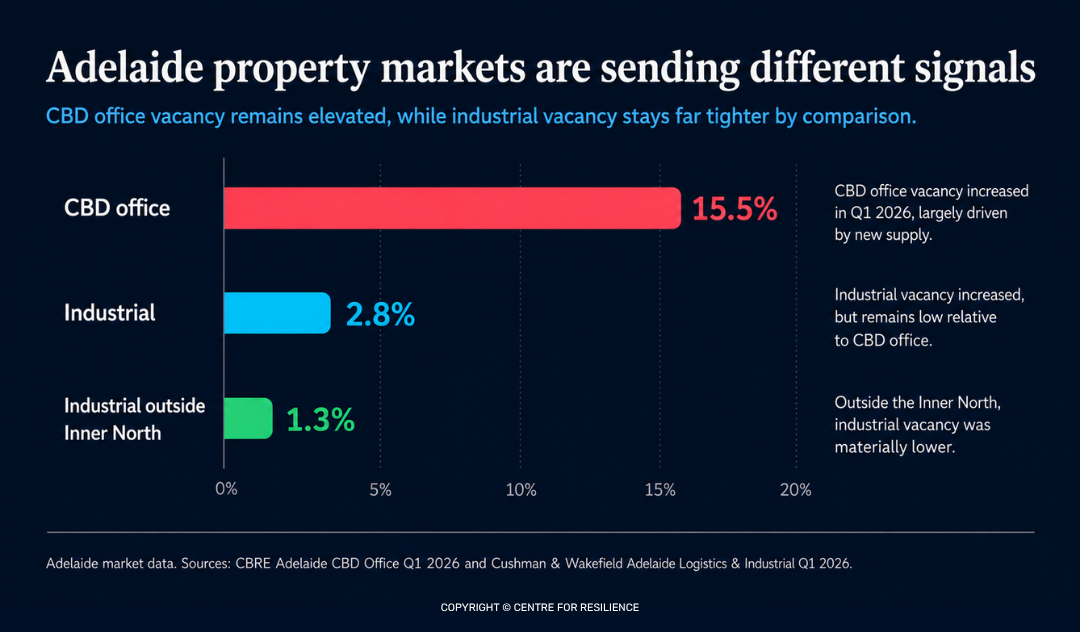
Adelaide’s CBD office market shows the same split. Vacancy was 15.5 per cent in Q1 2026, but the market was not uniformly weak. Newer and higher-quality office stock continued to attract demand, while older and secondary stock remained more exposed.
Retail is also divided.
CBRE reported South Australian household spending up 5.1 per cent year-on-year in February 2026, while Adelaide recorded about $37.4 million of retail transactions in Q1 2026 for deals above $5 million. But SOBE shows that retail and hospitality operators are carrying some of the hardest pressures. Retail respondents reported cost of doing business at 94 per cent and profitability pressure at 81 per cent. Hospitality respondents reported cost of doing business at 88 per cent and profitability pressure at 82 per cent.
Big projects can thrive, but small businesses can be squeezed. South Australia must ensure record investment reaches local suppliers, SMEs, main streets, CBD traders, manufacturers, hospitality and regional businesses. The record capex shows confidence; the SOBE report is a warning. Momentum exists, but it isn’t shared evenly.
A Resilience Lens
The record $3.1 billion private capital expenditure figure is a positive signal for South Australia, but it should not be read in isolation.
The more important resilience issue is distribution.
Industrial and logistics investment may strengthen productive capacity, supply chains, defence industry, warehousing and export capability. That is good for the state.
But the Business Chamber survey shows that many firms are still under heavy strain. Confidence has fallen, sales have weakened, profitability is at a 20-year low, cost pressures are near the top of the index range, and many businesses are absorbing costs rather than passing them on.
The risk is a capital-rich upper layer of the economy sitting above a stressed trading base.
The opportunity is to use the investment cycle to support SME modernisation, local procurement, energy efficiency, freight resilience, main-street renewal, CBD activation, workforce pathways and practical productivity improvements.
The question is no longer simply whether South Australia is attracting investment.
The harder question is whether that investment is reaching enough of the economy to build real resilience.
Sources:
Australian Bureau of Statistics - Private New Capital Expenditure and Expected Expenditure, Australia, methodology and March 2026 release.
South Australian Business Chamber - Survey of Business Expectations Report: March 2026 Quarter.
CBRE - Adelaide Industrial and Logistics Figures Q1 2026.
CBRE - Adelaide CBD Office Figures Q1 2026.
CBRE - Adelaide Retail Figures Q1 2026.
Cushman & Wakefield - Adelaide Logistics and Industrial MarketBeat Q1 2026.
Cushman & Wakefield - Adelaide CBD Office MarketBeat Q1 2026.
About C4R™ - CENTRE FOR RESILIENCE :
C4R™- CENTRE FOR RESILIENCE provides curated, source-based analysis and reporting, combining verified news with strategic insight and resilience-focused interpretation. For in depth analysis of topics like these reach out to C4R™.
C4R™ - CENTRE FOR RESILIENCE is an independent, Australian-based Think Tank advancing economic, social, infrastructure and leadership resilience through research, measurement and practical programs with business, government and community partners. Learn more at https://www.c4resilience.com/.
Media enquiries: via the C4R Contact page.