
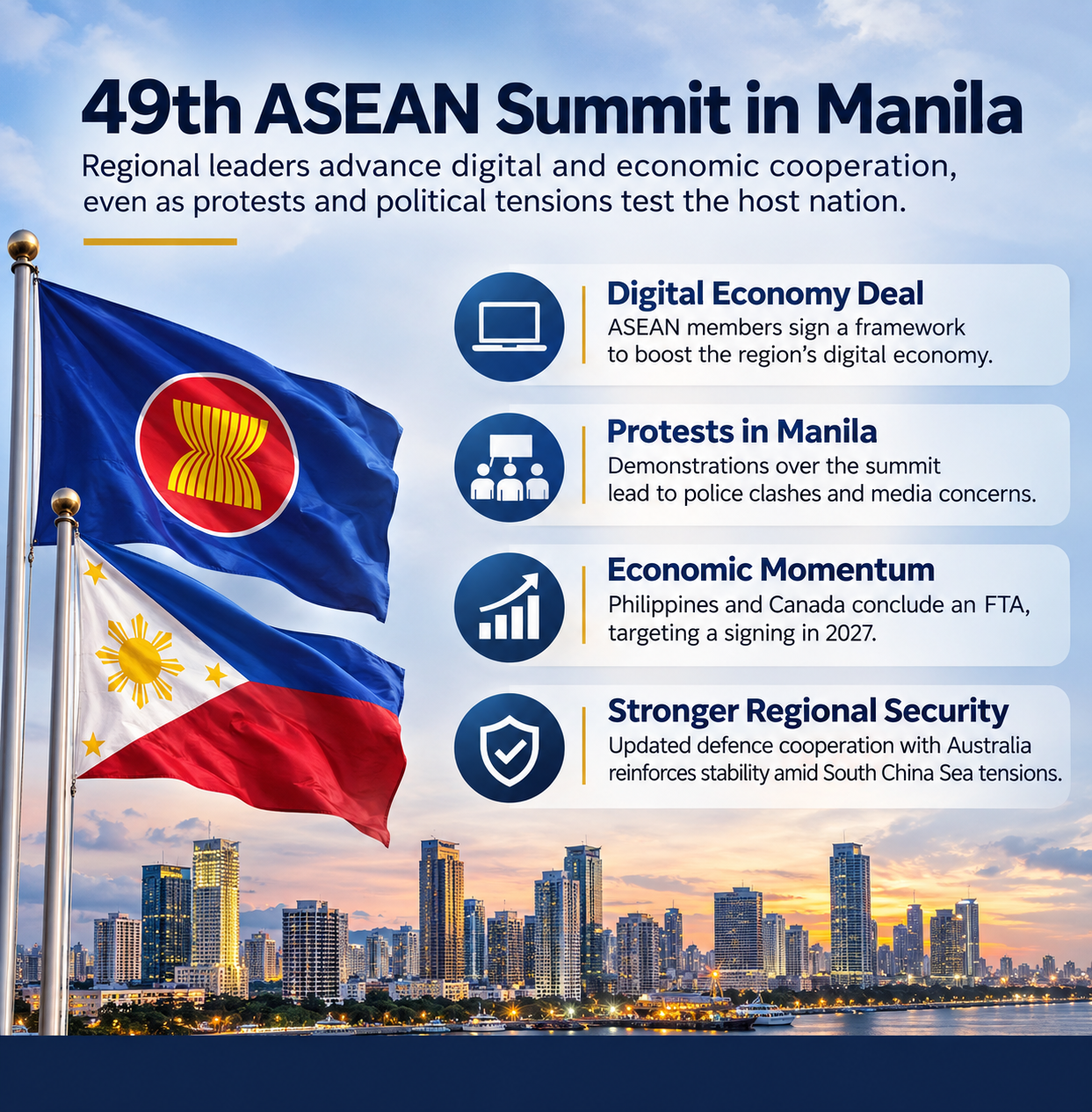
Image: Ai generated image
ASEAN Diplomacy, South China Sea Tensions and the Future of Regional Resilience
C4R - CENTRE FOR RESILIENCE | 16 November 2026
Manila's hosting of the 49th ASEAN Summit illustrates the growing relationship between regional security, economic integration, critical minerals and domestic institutional resilience.
The Philippines has emerged as a significant strategic meeting point for competing geopolitical, industrial and economic priorities as President Ferdinand Marcos Jr. hosts Southeast Asian leaders and international partners at the 49th ASEAN Summit in Manila.
Taking place from 14 to 17 November 2026, the summit has brought together discussions concerning regional trade, the digital economy, maritime security, energy pressures and cooperation with major international partners.
Yet the diplomatic activity has coincided with demonstrations, confrontations between protesters and police, and concerns over the treatment of journalists covering public gatherings.
These contrasting developments highlight a broader challenge: international partnerships can strengthen national resilience, but their benefits ultimately depend on domestic institutional capacity, economic performance and public confidence.
Digital integration and economic opportunity
One significant achievement has been the signing of the ASEAN Digital Economy Framework Agreement on 14 November.
The framework seeks to strengthen regional approaches to digital commerce, payments, electronic transactions, data and cybersecurity.
At the same time, Canada and the Philippines have concluded negotiations for a bilateral free trade agreement, targeting signature in 2027. Negotiations towards a separate Canada-ASEAN agreement have also substantially concluded.
These developments could support a more diversified trading environment across Southeast Asia.
However, the Philippines continues to experience significant cost-of-living pressures. Official statistics show annual headline inflation reached 7.8% in October 2026, driven in part by transport, energy and housing-related costs.
This illustrates why economic integration alone cannot guarantee national resilience.
China and the South China Sea
The most consequential security issue remains the maritime dispute between the Philippines and China.
Negotiators have provisionally agreed on approximately 80% of the proposed South China Sea Code of Conduct, but fundamental issues remain unresolved. Talks will continue in 2027 under Singapore's ASEAN chairmanship.
Although the negotiations demonstrate continued diplomatic engagement, repeated maritime confrontations highlight the distance between negotiating progress and practical security at sea.
For the Philippines, the challenge is to preserve its maritime interests while maintaining regional economic stability and reducing the potential for escalation.
For Australia and the broader Indo-Pacific, the implications extend to shipping continuity, investment confidence and regional security.
Australia and the Philippines strengthen defence cooperation
The signing of an updated Australia-Philippines defence cooperation arrangement on 15 November represents an important expansion of bilateral engagement.
The agreement covers maritime awareness, information-sharing, training, strategic dialogue, interoperability and defence infrastructure development.
Additional Australian support for regional maritime security and cyber resilience creates opportunities for more practical cooperation.
The relationship is increasingly relevant to wider industrial resilience, including defence sustainment, logistics, infrastructure and advanced technologies.
The United States and economic security
The Philippines' relationship with the United States remains central to its national security strategy.
Cooperation is also expanding beyond conventional defence into critical minerals, technology and advanced manufacturing.
A critical minerals memorandum of understanding signed in February 2026 provides a framework for supply-chain diversification and investment.
Meanwhile, the proposed Pax Silica initiative is being discussed as a potential advanced manufacturing and economic security project, although its principal agreement has not yet been finalised.
These initiatives could strengthen industrial diversification, provided they translate into bankable investments, functioning facilities and genuine domestic economic benefits.
Critical minerals become a regional strategic priority
One of the summit's most consequential longer-term developments is ASEAN's renewed emphasis on critical minerals.
A regional strategy is being advanced to strengthen value chains extending from mineral extraction to processing, refining, manufacturing and recycling.
The Philippines' significant nickel resources give it an important position in this discussion.
For Australia, the development reinforces the need to consider sovereign capability through the entire industrial chain rather than mineral deposits alone.
Domestic resilience remains fundamental
The ongoing impeachment proceedings involving Vice President Sara Duterte, the summit-related protests and continued volcanic activity at Mount Kanlaon illustrate separate but important pressures on institutional and emergency management capacity.
These developments should not be treated as equivalent threats or as evidence of general national instability. Each requires its own evidence, context and proportional assessment.
What this means
The Philippines is strengthening its international relationships while simultaneously managing maritime tensions, inflation, domestic political disputes and environmental hazards.
The most important strategic question is whether increased diplomatic and economic cooperation produces measurable improvements in infrastructure, economic continuity, industrial capacity, governance and preparedness.
C4R Resilience Lens
For C4R - CENTRE FOR RESILIENCE, the Philippines provides a significant example of the interaction between geopolitical exposure, domestic resilience and sovereign industrial capability.
Its strategic importance is growing, but greater importance does not itself establish greater fragility.
The longer-term test will be the Philippines' ability to convert international agreements and strategic attention into sustainable national capability.
Sources and References
-
ASEAN Secretariat - Official ASEAN Website
https://asean.org/ -
ASEAN Secretariat - 49th ASEAN Summit and Regional Cooperation
https://asean.org/ -
Philippine News Agency - ASEAN Summit, Regional Diplomacy and Critical Minerals
https://www.pna.gov.ph/ -
Philippine Statistics Authority - October 2026 Inflation Report
October 2026 Inflation Report -
Australian Department of Defence - Australia-Philippines Defence Cooperation
https://www.defence.gov.au/ -
Australian Department of Foreign Affairs and Trade - Philippines Country Brief
Philippines Country Brief -
Government of Canada - International Trade and Philippines Relations
https://www.international.gc.ca/ -
Philippine Embassy, Washington DC - Philippines-US Critical Minerals MOU
Critical Minerals Supply Chains MOU -
Philippine News Agency - ASEAN Critical Minerals Strategy
ASEAN Critical Minerals Strategy -
Philippines Executive Order No. 122 (2026) - Critical Minerals Policy
Executive Order No. 122 -
United States Geological Survey - Mineral Commodity Summaries 2026
Mineral Commodity Summaries 2026 -
World Bank WITS - Philippines Nickel Ore and Concentrate Exports, 2025
Philippines Nickel Exports 2025 -
Permanent Court of Arbitration - South China Sea Arbitration
South China Sea Arbitration -
PHIVOLCS - Philippine Institute of Volcanology and Seismology
https://www.phivolcs.dost.gov.ph/ -
National Union of Journalists of the Philippines - Press Freedom and Journalist Safety
https://nujp.org/ -
Philippine Senate - Legislative Proceedings and Impeachment Information
https://legacy.senate.gov.ph/ -
Philippine Department of Trade and Industry - Trade Agreements and Industrial Development
https://www.dti.gov.ph/
About C4R™ - CENTRE FOR RESILIENCE :
C4R™- CENTRE FOR RESILIENCE provides curated, source-based analysis and reporting, combining verified news with strategic insight and resilience-focused interpretation. For in depth analysis of topics like these reach out to C4R™.
C4R™ - CENTRE FOR RESILIENCE is an independent, Australian-based Think Tank initiative advancing economic, social, infrastructure and leadership resilience through research, measurement and practical programs with business, government and community partners.
Media enquiries: via the C4R Contact page.