
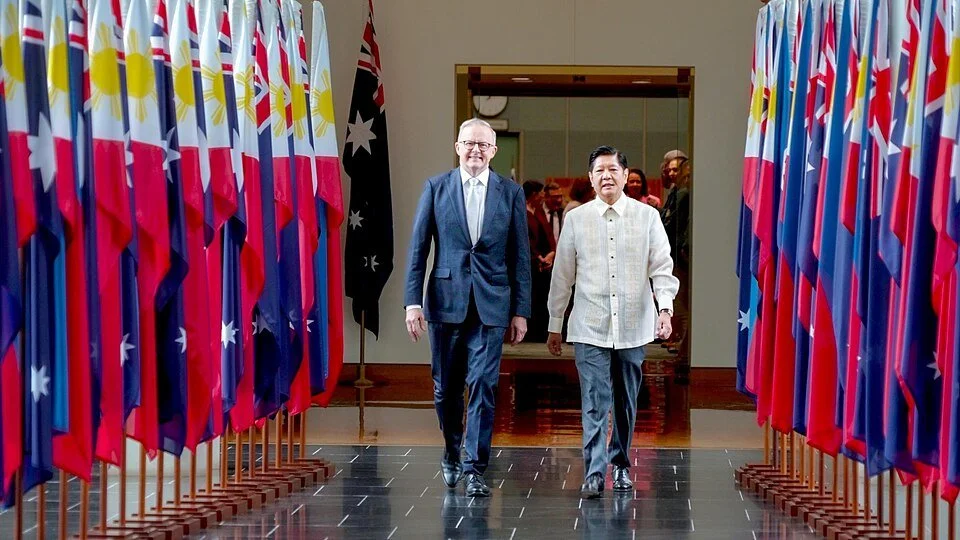
Image: Presidential Communications Office, Philippines
New bilateral agreements strengthen Australia's relationship with the Philippines, creating opportunities for regional stability, economic cooperation, industrial development and long-term resilience.
C4R - CENTRE FOR RESILIENCE | Updated 17 November 2026
Australia and the Philippines have entered a significant new phase in their strategic relationship, following a series of diplomatic, defence and economic commitments announced in Manila during the 49th ASEAN Summit.
On 15 November 2026, Australian Prime Minister Anthony Albanese witnessed the signing of a new Australia-Philippines Defence Cooperation Arrangement.
The following day, Prime Minister Albanese and Philippine President Ferdinand Marcos Jr. reaffirmed their bilateral Strategic Partnership through a new leaders' statement, Kasandigan: Philippines-Australia Leaders' Statement on Expanded Security and Defense Cooperation.
These developments build upon 80 years of diplomatic relations and demonstrate the growing importance of cooperation between Australia and one of Southeast Asia's most strategically significant nations.
Although defence and maritime security remain important elements of the relationship, the broader opportunity extends to trade, investment, economic development, education, sustainable industry, technology and community resilience.
The challenge for both countries will be to convert stronger diplomatic engagement into lasting economic, institutional and social benefits.
A Strengthening Strategic Partnership
Australia and the Philippines established diplomatic relations in 1946 and elevated their relationship to a Strategic Partnership in September 2023.
Their relationship has developed across government, business, education, community engagement and regional cooperation.
The agreements announced in November 2026 represent another stage in this development, reflecting shared interests in regional stability, international cooperation and sustainable economic growth.
The bilateral leaders' statement reinforces the importance of cooperation built upon mutual respect, established international rules and the capacity of nations to make their own sovereign decisions.
For Australia, the Philippines is an increasingly important partner in a region that contributes significantly to international commerce, investment and economic development.
For the Philippines, cooperation with Australia offers opportunities to strengthen longstanding institutional relationships and broaden economic and educational engagement.
Australia Reaffirms Its Commitment to Regional Stability
Prime Minister Anthony Albanese emphasised Australia's commitment to working closely with ASEAN and its regional partners.
"Australia is committed to working closely with ASEAN to help shape a region that is peaceful, stable and prosperous."
"Our new Defence Cooperation Arrangement will strengthen defence and maritime security ties, while increased investment in Southeast Asia Maritime Partnerships addresses shared maritime challenges."
Anthony Albanese MP, Prime Minister of Australia
The Prime Minister's remarks reinforce the importance Australia places on constructive regional relationships and continued engagement with Southeast Asian nations.
Australia's long-term national interests are closely connected to the economic stability, prosperity and security of the wider Indo-Pacific.
The Philippines represents an important partner in strengthening those relationships.
Defence Cooperation and Regional Security
The Defence Cooperation Arrangement signed on 15 November provides an updated framework for continued engagement between Australia and the Philippines.
It builds upon established bilateral defence relations and reflects a shared commitment to regional peace and stability.
Deputy Prime Minister and Minister for Defence Richard Marles highlighted the importance of the relationship.
"Australia and the Philippines share a strong commitment to a peaceful, stable and prosperous Indo-Pacific, underpinned by respect for international law."
"This new Defence Cooperation Arrangement will deepen practical cooperation between our defence forces and create new opportunities to work together in support of regional security."
Richard Marles MP, Deputy Prime Minister and Minister for Defence
The strengthened partnership contributes to Australia's broader diplomatic and security engagement throughout Southeast Asia.
It also demonstrates the importance of maintaining constructive relationships, open dialogue and cooperation between nations with shared interests in regional stability.
While defence cooperation is an important component of the relationship, its wider significance includes the confidence and continuity that a stable regional environment can provide for business, investment and communities.
International Law, Sovereignty and Regional Stability
Maritime security and respect for international law remain important considerations throughout the Indo-Pacific.
Australia and the Philippines have reaffirmed their commitment to peaceful dispute resolution, freedom of navigation and established international legal principles.
Minister for Foreign Affairs Penny Wong emphasised the importance of respecting national sovereignty.
"Australia's interests lie in a region where sovereignty is respected, international law is upheld and countries can make their own choices."
"Together with the Philippines and our regional partners, we are strengthening maritime resilience and security that helps underpin a peaceful, stable and prosperous region."
Senator the Hon Penny Wong, Minister for Foreign Affairs
The importance of these principles extends beyond governments and defence institutions.
Regional stability contributes to business confidence, investment, trade relationships and the ability of countries to pursue sustainable economic development.
For Australia and the Philippines, continued diplomatic engagement provides an important foundation for maintaining constructive relationships and reducing uncertainty.
Eighty Years of Diplomatic and Economic Relations
The relationship between Australia and the Philippines extends well beyond government-to-government cooperation.
Economic, educational and community connections have strengthened over successive decades.
According to the Australian Department of Foreign Affairs and Trade, bilateral goods and services trade reached approximately A$10.8 billion in 2025.
More than 250 major Australian companies operate in the Philippines, collectively employing over 41,000 people across a range of industries.
The Philippines also represents a substantial consumer market, with a population exceeding 110 million people.
Both countries participate in established regional trading arrangements, including the ASEAN-Australia-New Zealand Free Trade Area and the Regional Comprehensive Economic Partnership.
These arrangements provide an important foundation for continued commercial cooperation and investment.
The ASEAN-Australia Joint Leaders' Statement adopted on 16 November 2026 further reinforces cooperation in economic development, trade, investment, education and sustainable growth.
Expanding Trade, Investment and Business Opportunities
A stronger bilateral relationship could provide opportunities for Australian and Philippine businesses to develop new partnerships and expand their activities in both markets.
Sectors with potential relevance include agriculture, food production, tourism, hospitality, education, resources, technology, infrastructure and professional services.
One recent example is the announced expansion of Philippine restaurant company Jollibee into Australia.
On 15 November 2026, franchise arrangements were announced for New South Wales and Victoria, with plans targeting approximately 35 restaurants over five years.
The proposed expansion represents an estimated A$60 million investment and approximately 900 direct jobs, subject to implementation.
The announcement demonstrates how stronger international commercial relationships can support new business opportunities and employment.
For Australian businesses, the Philippines offers access to an established Southeast Asian market with opportunities for further investment, collaboration and commercial development.
For Philippine businesses, Australia provides opportunities to participate in a mature economy with established commercial institutions and substantial international connections.
Critical Minerals, Resources and Sustainable Industrial Development
Resources and sustainable industrial development represent another potential area for cooperation between Australia and the Philippines.
Both countries have established interests in natural resources, industry and the economic opportunities associated with emerging technologies.
The Philippines is an important producer of nickel and other mineral resources, while Australia has extensive experience in resource development, mining services, engineering and industrial innovation.
The ASEAN-Australia Joint Leaders' Statement of 16 November also identifies sustainable critical minerals development as an area for potential regional cooperation.
This provides a foundation for exploring partnerships involving responsible resource development, research, skills and sustainable industrial practices.
For Australia, there is an opportunity to support international partnerships that complement domestic industry and contribute to long-term economic resilience.
For the Philippines, deeper collaboration could assist with industrial development, workforce capabilities and sustainable economic participation.
Any future investment would need to be assessed on its commercial merits, environmental responsibilities, community benefits and contribution to long-term economic value.
The broader strategic consideration is that international resource cooperation should support sustainable industrial development and mutual economic benefit.
Energy, Infrastructure and Sustainable Development
Energy security and reliable infrastructure are important foundations of economic development.
The latest bilateral and ASEAN-Australia statements recognise the importance of cooperation in sustainable energy, infrastructure investment and economic stability.
Both Australia and the Philippines face the challenge of supporting economic growth while adapting to changing energy markets, technological development and environmental expectations.
Opportunities may emerge through investment, research, infrastructure planning and knowledge-sharing.
These areas are particularly relevant to the long-term competitiveness of businesses, communities and national economies.
Successful cooperation will depend on appropriate policy frameworks, commercially viable investment and the ability to deliver sustainable outcomes.
Technology, Education and Workforce Development
Technology and education provide further opportunities to strengthen the bilateral relationship.
Australia and the Philippines have established connections through universities, vocational education, research, business services and professional employment.
The November ASEAN-Australia commitments reinforce the importance of digital development, education, innovation and workforce capability.
Future cooperation may support professional education, research collaboration, technical training and the exchange of knowledge between institutions.
Developing skilled workforces and supporting innovation are increasingly important to productivity, economic adaptability and sustainable development.
These relationships also provide long-term benefits by strengthening professional and community connections between both countries.
What Could This Mean for South Australia?
South Australia has an established relationship with Southeast Asian markets through trade, education, resources, tourism, professional services and investment.
The strengthening Australia-Philippines partnership provides an opportunity to consider how South Australian businesses and institutions might participate in future bilateral initiatives.
Areas of potential cooperation include:
Education, vocational training and professional development.
Responsible resources development and environmental services.
Engineering, technology and industrial innovation.
Sustainable infrastructure and energy development.
Agriculture, food production and agribusiness.
Tourism, hospitality and cultural exchange.
Research, professional services and business collaboration.
South Australian universities, research institutions, industry organisations and businesses may be well placed to explore opportunities within these sectors.
However, opportunities should be approached through conventional commercial, regulatory and investment processes, with clear consideration of economic viability and mutual benefit.
A stronger bilateral relationship can create an enabling environment for business development, but it does not automatically establish particular projects, investments or market opportunities.
Climate Adaptation and Community Resilience
Australia and the Philippines both face significant environmental challenges.
The Philippines regularly experiences typhoons, flooding, earthquakes and volcanic activity, while Australia faces bushfires, floods, extreme weather and other natural hazards.
These shared challenges create opportunities for cooperation in community preparedness, environmental management, education and sustainable development.
Australia's Development Partnership Plan for the Philippines 2024-2029 already recognises the importance of strengthening institutional and community resilience.
Exchanging knowledge and experience in these areas can benefit both countries and contribute to broader regional development.
The longer-term objective should be to strengthen community wellbeing, preparedness and the capacity of societies to adapt to changing circumstances.
What Could Happen Next?
The strengthening Australia-Philippines relationship creates opportunities across several areas over the coming years.
Diplomatic cooperation: Continued engagement between governments and regional institutions.
Economic development: Greater business participation, commercial investment and bilateral trade opportunities.
Industry and resources: Collaboration in responsible resource development, industrial innovation and sustainable business practices.
Education and research: Expanded institutional partnerships, technical training and workforce development.
Energy and infrastructure: Cooperation in sustainable investment, infrastructure development and energy transition initiatives.
Tourism and cultural exchange: Stronger connections through travel, hospitality, business and community engagement.
Community resilience: Greater knowledge-sharing in environmental management, disaster preparedness and sustainable development.
These potential outcomes represent areas for exploration rather than confirmed investments or government commitments.
Their success will depend upon effective implementation, appropriate investment and continued cooperation between governments, businesses and communities.
What This Means
The Australia-Philippines relationship is developing into an increasingly important partnership for regional cooperation, economic development and long-term stability.
The agreements announced during the November 2026 ASEAN Summit strengthen an established diplomatic foundation and provide further opportunities for engagement across government, industry and communities.
For Australian businesses, the relationship may support greater participation in one of Southeast Asia's important emerging markets.
For South Australia, potential opportunities exist in education, resources, sustainable industry, technology, tourism and professional services.
The emphasis should now be on developing relationships and initiatives that are commercially viable, environmentally responsible and capable of providing long-term benefits.
C4R Resilience Lens
For C4R - CENTRE FOR RESILIENCE, the Australia-Philippines relationship illustrates how international partnerships can contribute to economic stability, sustainable development, institutional cooperation and broader regional resilience.
Resilience is not determined solely by defence agreements, diplomatic relationships or economic growth.
It is also influenced by the strength of communities, the adaptability of institutions, the sustainability of economic activity and the ability of nations to cooperate when circumstances change.
A constructive and diversified international partnership can provide opportunities for learning, innovation and long-term development.
The enduring value of the Australia-Philippines relationship will be reflected in the strength of the institutions, businesses and communities it supports, and the sustainable outcomes achieved over time.
As both countries mark 80 years of diplomatic relations, their strengthened partnership provides an opportunity to build upon a shared history and pursue a more prosperous, stable and resilient future.
Sources and References
1. Australian Prime Minister - Enhancing Defence Cooperation and Maritime Security in Southeast Asia, 15 November 2026
https://www.pm.gov.au/media/enhancing-defence-cooperation-and-maritime-security-southeast-asia
2. Australian and Philippine Leaders - Kasandigan: Philippines-Australia Leaders' Statement, 16 November 2026
https://www.pm.gov.au/media/kasandigan-philippines-australia-leaders-statement-expanded-security-and-defense-cooperation
3. ASEAN-Australia Joint Leaders' Statement, 16 November 2026
https://www.pm.gov.au/media/asean-australia-joint-leaders-statement-5th-anniversary-asean-australia-comprehensive
4. Australian Department of Foreign Affairs and Trade - Philippines Country Brief
https://www.dfat.gov.au/geo/philippines/philippines-country-brief
5. Australian Department of Foreign Affairs and Trade - Australia-Philippines Strategic Partnership Declaration
https://www.dfat.gov.au/countries/joint-declaration-strategic-partnership-between-republic-philippines-and-commonwealth-australia
6. Australian Department of Foreign Affairs and Trade - Southeast Asia Economic Strategy to 2040
https://www.dfat.gov.au/countries-economies-and-regions/southeast-asia/invested-australias-southeast-asia-economic-strategy-2040/appendixes/philippines-country-profile-and-action-plan
7. Australian Prime Minister - Jollibee Coming to Australia, 15 November 2026
https://www.pm.gov.au/media/jollibee-coming-australia
8. Australian Department of Foreign Affairs and Trade - Australia-Philippines Development Partnership Plan 2024-2029
https://www.dfat.gov.au/publications/development/australia-philippines-development-partnership-plan
9. ASEAN Secretariat - Official ASEAN Website
https://asean.org/
About C4R™ - CENTRE FOR RESILIENCE :
C4R™- CENTRE FOR RESILIENCE provides curated, source-based analysis and reporting, combining verified news with strategic insight and resilience-focused interpretation. For in depth analysis of topics like these reach out to C4R™.
C4R™ - CENTRE FOR RESILIENCE is an independent, Australian-based Think Tank initiative advancing economic, social, infrastructure and leadership resilience through research, measurement and practical programs with business, government and community partners.
Media enquiries: via the C4R Contact page.